

Gartner's 2024 Security & Risk Management data puts average enterprise IAM program spend at 18% of the total security budget — the single largest security line item for organizations above 10,000 employees. Yet in every independent TCO analysis across Life Sciences, Healthcare, Automotive, and Telecom, the true fully-loaded cost of ownership runs two to four times what the CISO believes it to be, and five to ten times what the CFO has ever been told. That delta is not rounding error. It is structural invisibility — and LENS™ surfaces it in every enterprise posture diagnostic we run.
The number that constitutes this gap does not appear on any security dashboard. It does not live in the annual security report, the risk register, or the vendor contract renewal deck. It is not tracked in ServiceNow, not surfaced by Splunk, and not visible in any GRC platform currently deployed across the Fortune 500. That number is the true, fully-loaded total cost of ownership of the enterprise identity stack.
The architectural archaeology looks the same every time: an Okta tenant never decommissioned after an acquisition, a SailPoint IdentityNow instance running independently in a business unit that broke away during a digital transformation three years ago, a CyberArk PAM deployment IT Operations still maintains separately because the security team's rollout never absorbed the legacy server estate. Each carries its own license cost, integration maintenance burden, operational staffing overhead, and breach exposure surface. None appear as a discrete line item. All are quietly consuming budget the organization believes is being spent elsewhere.
This is the Identity Tax — a calculable financial liability accumulating silently across four cost dimensions: direct licensing redundancy, integration debt servicing, operational friction losses in workforce productivity, and breach exposure amplification that correlates directly with identity posture immaturity. Most organizations are paying all four simultaneously. Almost none have measured it. Without measurement there is no accountability, no optimization pathway, and no credible investment case for a board that demands security spending be justified in financial risk terms — not technical capability.
IAM is not a cost center. Unoptimized IAM is a cost center. Mature IAM is a financial risk reduction instrument with measurable, defensible ROI — and the delta between those two states is precisely what this piece is designed to quantify.
The True Cost of Identity Debt: What Your CFO's Spreadsheet Cannot Capture
Identity debt is the accumulated liability that forms when access architecture decisions — made under time pressure, organizational change, or budget constraint — are never rationalized, consolidated, or retired. It is the IAM equivalent of technical debt in software engineering, but with a critical distinction: the interest rate is not linear. Identity debt compounds against you the moment a threat actor finds the seam between two poorly integrated systems, exploits a stale service account provisioned during a merger and never deprovisioned, or leverages an orphaned OAuth token to move laterally through a cloud environment your posture tooling never covered.
The CFO's spreadsheet captures direct licensing costs because those appear on invoices. It occasionally captures professional services spend because that flows through procurement. What it systematically fails to capture are the four invisible cost categories that together constitute the majority of true IAM TCO for a mid-enterprise organization running between 5,000 and 50,000 identities.
The first invisible category is integration debt servicing cost. Every identity tool requires connectors, APIs, and middleware to function within the broader architecture. When Okta's SCIM provisioning to a downstream SaaS application breaks — typically after a vendor-side API version deprecation your team discovers reactively — the cost is not the hour to fix the connector. The cost is the accumulated remediation labor across all tickets raised because access requests were failing silently, plus the compliance exposure from the period during which your joiner-mover-leaver process was functionally broken, plus the audit finding that surfaces six months later when access certification data shows provisioning gaps nobody flagged in real time.
The second invisible category is orphaned entitlement carrying cost. Orphaned entitlements do not announce themselves. They accumulate silently, compounding access risk with each missed certification cycle, each unreviewed role assignment, each service account that outlived its original workload. In a mature SailPoint IdentityNow deployment, the governance engine can trigger automated access reviews on schedule, flag accounts exceeding inactivity thresholds, and generate remediation tasks routing to the appropriate application owner. That capability is real and works — when configured correctly, when the application owner list is current, and when business roles reflect actual job function rather than the organizational structure that existed during the last HR migration.
The operational reality is that none of those conditions are permanently stable. Business roles drift. Application owners turn over. Inactivity thresholds get set conservatively at rollout and never revisited. The result is a governance engine that is technically operational but functionally rubber-stamping stale access rather than interrogating it.
What this means at the data layer is measurable. A large enterprise operating SailPoint IdentityIQ with eighty thousand normalized accounts will typically carry between 15% and 25% of its access entitlements in a state that cannot be positively confirmed as currently required for business function. That number surfaces when you run an independent entitlement analysis, cross-reference against HR activity records and application authentication logs, and subtract accounts showing evidence of recent purposeful use from the total population. The delta — access that exists but cannot be justified — is the orphaned entitlement carrying cost, and at enterprise scale it represents a persistent lateral movement surface threat actors know exactly how to exploit.
The SolarWinds supply chain breach did not require brute-forcing privileged credentials. It required a foothold and an environment where access entitlements had accumulated beyond any single team's awareness. The 2023 Okta support system breach followed the same pattern — a compromised account with access to customer tenant data because the access model was never scoped to minimum necessary for the support function. Both were architectural failures in access model maintenance, exactly the category of failure a static, point-in-time access review program cannot prevent because the conditions enabling breach exist between review cycles.
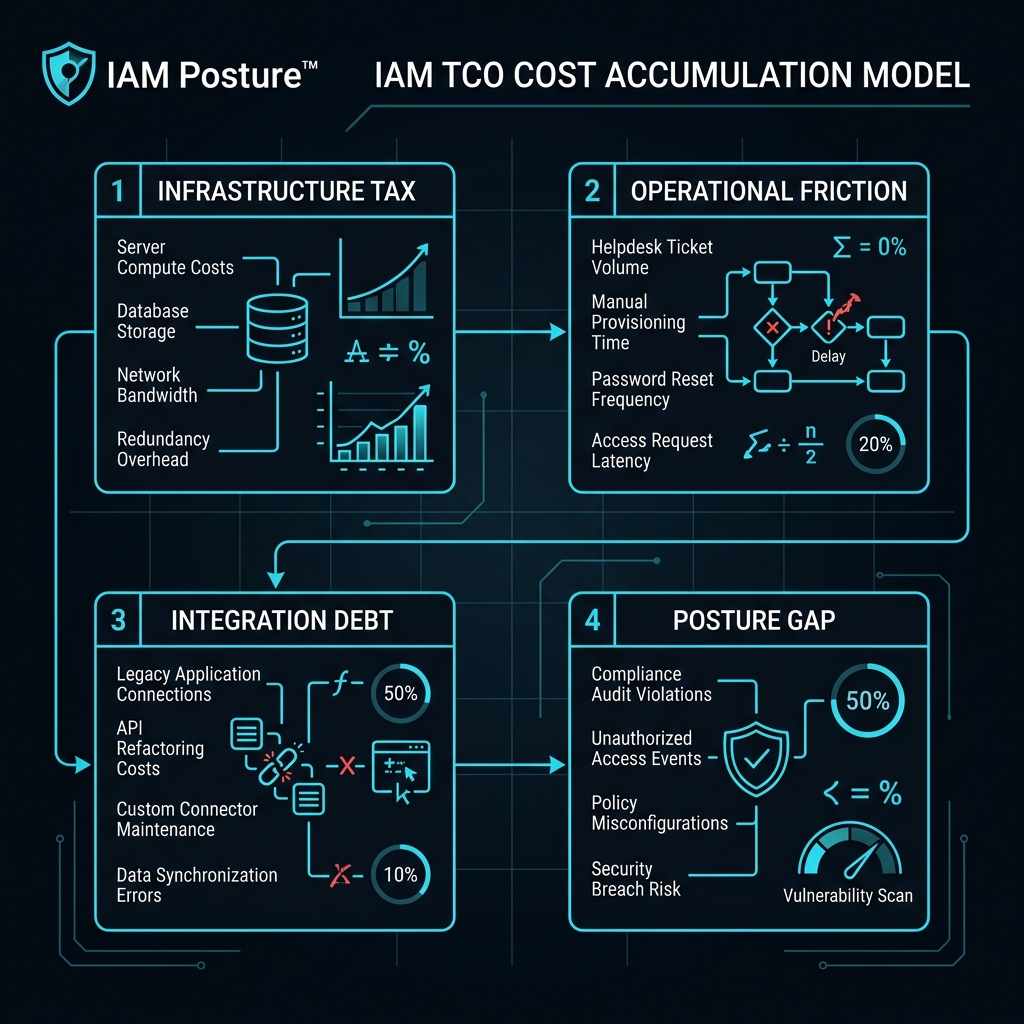
The diagram above maps the Identity Tax accumulation model — showing how direct licensing redundancy, integration debt, orphaned entitlement carrying cost, and PAM coverage gaps compound silently across the four cost dimensions that never appear on a single dashboard.
The Privileged Access Carrying Cost That Finance Never Sees
CyberArk's Privileged Access Manager is the market reference for vault-based credential management, and for organizations that have deployed it at meaningful depth — actual vaulting of service account passwords, SSH keys, and API credentials, not just Windows administrator accounts in the initial scope — it delivers genuine risk reduction. The problem is that "meaningful depth" describes a minority of deployments relative to the licensed scope.
The typical enterprise CyberArk deployment at eighteen months has vaulted tier-zero Windows server administrative accounts, completed PAM onboarding for production database administrators, and is somewhere in the middle of a service account discovery effort that produced a list far longer than anticipated. That list is long because service accounts multiply in direct proportion to application sprawl, and application sprawl moves faster than any PAM onboarding program can run without dedicated resourcing that was not in the original project budget.
The accounts not yet onboarded to the vault are not protected by the vault. They may carry static credentials that have not rotated since provisioning. They may hold excessive privileges granted at initial configuration because the application team needed the integration to work by a deployment deadline and scoped permissions broadly — an intention to restrict later that has not been executed.
Quantifying this gap requires combining CyberArk discovery scan output with Active Directory service account enumeration, then cross-referencing against application dependency maps to identify which unvaulted accounts have paths to sensitive systems. Most organizations have not done this analysis. They know conceptually that service accounts exist outside the vault. They do not know how many, which systems those accounts can reach, or the credential age distribution across that population.
That gap — the delta between what your PAM tooling knows and what actually exists — is a number your CISO should cite from memory. It represents the privileged access attack surface your adversaries are mapping right now while your team focuses on the next certification cycle. The carrying cost of not knowing it is denominated in breach probability, dwell time, and the lateral movement distance an attacker covers before detection controls fire — assuming they fire at all against credential-based movement that looks, from the SIEM's perspective, like normal administrative activity.
Measuring the Tax: Three Controls That Convert Cost Visibility Into ROI
Three governance controls consistently move organizations from Identity Tax accumulation to Identity Tax reduction — and all three are measurable against financial outcomes, not just security metrics.
Continuous Discovery: You cannot govern what you haven't inventoried — across cloud control planes, SaaS directories, CI/CD pipelines, and runtime metadata — in an environment where infrastructure is provisioned in hours, not quarters. Organizations that run continuous discovery against their full identity population, not just the scope their IGA platform was configured to cover at initial deployment, consistently find between 30% and 60% more identities than their current governance program accounts for. That delta is the Identity Tax's raw material.
Immutable Ownership Attribution: Every identity — human and machine — must be bound to a named accountable party. Without this binding, lifecycle governance has no enforcement anchor and credential sprawl will always outpace remediation. The carrying cost of unowned identities is not theoretical; it is the direct driver of the orphaned entitlement accumulation documented above.
Automated Least-Privilege Enforcement: Governance at the velocity of modern identity provisioning cannot be manual. Continuous controls that detect permission drift and enforce rotation policy without requiring a ticket for each individual identity are the difference between an identity program that scales with the business and one that falls further behind with every sprint cycle.
Actionable Knowledge Gap
Most identity programs measure process execution — certifications run, tickets closed, connectors active. LENS™ measures something different: the gap between what your governance program believes it covers and what your environment actually contains. That gap is your Identity Tax, and it is calculable, attributable, and reducible.
Can you produce, right now, a line-item breakdown of every identity system your organization is actively licensing — including the ones IT Operations runs independently of the security team — with total cost of ownership, coverage scope, and the percentage of your actual identity population that falls outside each system's governance boundary?
Take the Free IAM Posture Assessment — Find Out Where Your Identity Tax Is Actually Accumulating

Fayaz Mulla Syed is an IAM and Cybersecurity leader and practitioner who has spent 13+ years at the forefront of enterprise identity — architecting, delivering, and evolving IAM programs across Life Sciences, Healthcare, Automotive, and Telecom. He brings rare depth across the full identity stack: from privileged access and identity governance to zero trust architecture and cloud identity — having worked hands-on in some of the most complex, regulated environments in the industry. He is the founder of IAM Posture™ — a vendor-neutral scoring platform built to cut through vendor noise and give organizations a clear, architectural view of where their identity program actually stands.