
The 2025 Verizon DBIR found that T1078 — Valid Accounts — was the most common attack technique across breaches for the third consecutive year. Not a novel exploit. Not a zero-day. Stolen or abused credentials on accounts that should not have existed, should have been rotated, or should have had standing access removed. That is the problem Palo Alto Networks just paid $25 billion to own. On May 12, 2026, they announced Idira on stage at the final CyberArk Impact conference in Austin — CyberArk rebranded, with agentic AI identity controls built on top, owned by a platform company whose commercial thesis depends on selling you a platform.
If you have a CyberArk deployment, a renewal in the next 12 months, or a PAM evaluation currently in progress — this changes your calculus. The LENS™ posture scoring model is designed to surface exactly this kind of vendor transition event: not because the tool changed, but because the ownership, commercial incentives, and roadmap accountability structure around it just changed entirely. When those three things shift simultaneously, your posture score changes even if your environment does not. That is not a nuance. That is the gap.
What Actually Happened and When
The timeline matters because the implications are sequential, and most CISOs know only the headline.
July 30, 2025 — Palo Alto announced a definitive agreement to acquire CyberArk for approximately $25 billion. Palo Alto shares dropped 3.5% on announcement. CyberArk jumped 13%. Markets priced acquisition premium enthusiasm on one side and overpayment concern on the other.
February 11, 2026 — The deal closed after regulatory clearances in the US, EU, UK, and Israel. CYBR delisted from NASDAQ. The identity security category's most storied independent vendor became a division of a network security platform company.
February 12, 2026 — One day after close, Palo Alto cut over 500 CyberArk positions. 700 jobs total were ultimately eliminated — over 10% of CyberArk's global workforce. The cuts concentrated in finance, HR, marketing, sales, and customer success — not R&D. We will come back to this.
May 12, 2026 — At CyberArk Impact in Austin, Palo Alto launched Idira. The CyberArk brand is being phased out. Idira is the third pillar of Palo Alto's platform alongside Strata (network) and Cortex (SOC).
Three months from close to brand launch. That is fast for an acquisition of this complexity. It tells you exactly how load-bearing identity is to Palo Alto's platform thesis — not a bolt-on, but the foundational third leg.
700 Jobs Cut the Day After Close: The Most Useful Data Point in This Transaction
On February 12, 2026 — one business day after close — Palo Alto eliminated more than 500 CyberArk positions. According to Globes and CTech, CyberArk employees did not receive a welcome email that morning. They received termination notices directly from Palo Alto Networks. Some managers did not know in advance which of their direct reports would be affected. No warning. No town hall.
This matters for two reasons. First: the people who knew your account, your deployment architecture, your renewal history, and your open support tickets — many of them are gone. The institutional knowledge in CyberArk's customer success and professional services teams was partially eliminated in a single morning. Second: the manner of the layoffs tells you something precise about how Palo Alto executes operationally. CEO Nikesh Arora had said publicly before close that there was "no such intention" to cut at that scale. That gap between stated intent and executed action is useful information when evaluating contractual commitments from this vendor going forward.
If you have a complex deployment underway or a custom integration that relied on a specific CyberArk PS relationship — find out who owns that now, before you need them at 2am.
The Platformization Trap: Why This Acquisition Is Structurally Different
CyberArk's previous acquisitions — Venafi for $1.54B in 2024, Idaptive in 2020, Conjur in 2017 — each expanded the product surface while leaving CyberArk's independence and commercial structure intact. The company remained answerable to identity security customers.
This is structurally different. Palo Alto's entire commercial strategy — what they call "platformization" — is to consolidate enterprise security spend across network, cloud, and now identity onto a single vendor relationship. They have executed this successfully in SASE and security operations. The CyberArk acquisition is the identity chapter.
Devroop Dhar, Co-founder and CEO at Primus Partners, put the tradeoff precisely: "The advantage here is ease of operation, a consolidated view, and greater integration. The downside is less flexibility over time." That "less flexibility" does not arrive as a policy change. It arrives as a conversation about "rationalizing your security stack." If you already run Prisma SASE or Cortex XDR, the pitch will be pricing efficiency. The math may look attractive in year one. The risk is year three and year five, when the bundle has become structural dependency.
Forrester found that bundling discounts rank lowest in enterprise platform selection criteria — ease of integration and productivity gains top the list — and buyers who chose bundles for pricing often regretted it when integration quality did not deliver. KuppingerCole raised the precedent concern directly, citing EMC/RSA and Broadcom/CA as acquisitions where integration eroded product focus. RSA spent a decade in post-acquisition drift before being spun out. CyberArk's roadmap answered to identity security customers. Idira's roadmap answers to Palo Alto's platform thesis. Whether Conjur, Venafi's certificate lifecycle capabilities, and the CyberArk Marketplace ecosystem receive the same engineering investment as standalone products — or become subordinated to Prisma integration priorities — is an open question practitioners were asking on the conference floor. The answers were not there yet.
The architectural gap in PAM programs is rarely the tool. It is the governance structure around it. An ownership change is precisely the event that exposes whether that structure was built on the vendor's accountability or yours.
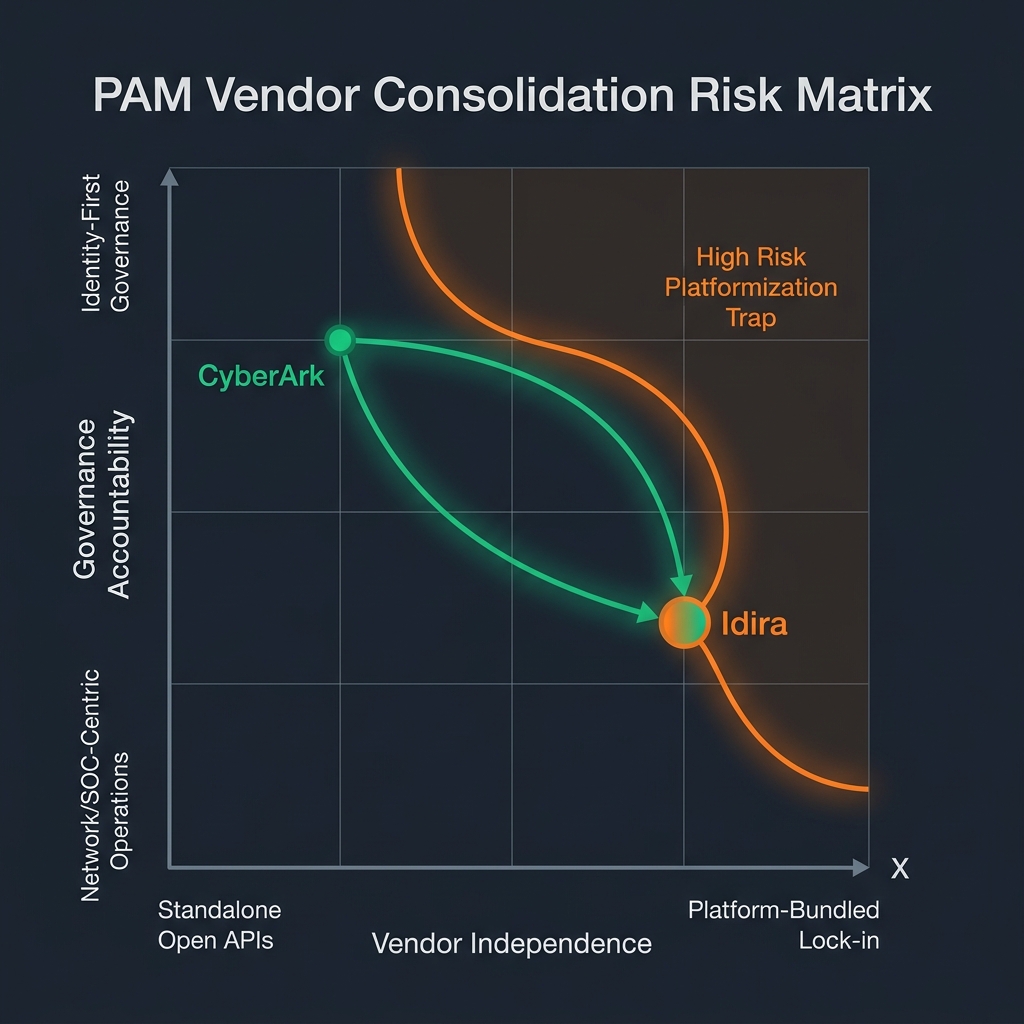
The PAM Vendor Consolidation Risk Matrix maps your current platform exposure across two axes: vendor independence (from standalone-with-open-APIs on the left to platform-bundled-lock-in on the right) and governance accountability (from identity-first ownership at the top to network/SOC-centric ownership at the bottom). Idira's post-acquisition position moves it right and down simultaneously — higher bundle pressure, lower identity-first accountability. The governance failure the diagram visualizes is the gap between where your PAM tool sits today and where the ownership incentives are pulling it: a buyer evaluating on 2025 architecture is making a 2027 commercial decision.
What Idira Delivers — and What the Acquisition Does to Agentic Identity Governance
The Secure AI Agents capability is the most technically substantive addition CyberArk's architecture was never designed to close. Idira continuously scans SaaS, cloud, and developer environments to discover active AI agents — LangChain runtimes, Copilot Studio deployments, GitHub Actions OIDC workflows — and enriches each with ownership, permission scope, and actual usage context. Amit Jaju, Senior Managing Director at Ankura Consulting, described what makes this different: "Instead of granting an agent static access tokens... Idira dynamically elevates privileges exactly when an agent needs to execute a task and instantly revokes them afterward." That is a meaningful departure from the vault-and-checkout model.
The accountability vacuum named in the section above — a PAM tool that now answers to a platform company's commercial priorities rather than identity-first governance — is precisely the structural gap that agentic AI multiplies. LangChain agent chains call external APIs using inherited OAuth tokens with no per-tool authorization step. GitHub Actions OIDC tokens carry cloud permissions granted at workflow creation and never reviewed. An agentic deployment's audit trail attributes every downstream action to the delegating human, not the agent — so your governance program can confirm that a task ran, but not what the agent did or accessed during it. The traditional PAM governance cycle — periodic certification, manual access reviews — cannot operate at the provisioning velocity of autonomous agent deployments. That is not a process problem. It is a structural incapability.
Zero Standing Privilege (ZSP) as a default posture — rather than an opt-in configuration — is Idira's most meaningful architectural shift. No standing credentials exist to steal. The 2025 NHIMG State of NHI Security found that 97% of non-human identities carry excessive privileges, and the CyberArk Identity Security Landscape report documented machine identity ratios exceeding 45:1 against human accounts across enterprise environments. That scale is what standing access looks like at rest. ZSP removes the target. The question is whether Palo Alto's platform consolidation model preserves the governance accountability required to enforce it — or whether identity decisions begin to defer to network and SOC priorities over time.
The core PAM engine is still CyberArk's. Conjur is CyberArk's. The vault, session recording, and PAM discovery work the same way. Idira extends the surface area on hardcoded secrets and CI/CD pipeline credentials; it does not invent the answer to those problems. The inventory problem precedes any tooling decision — and no rebrand resolves it.
Your Contract Is a Negotiation Window That Is Already Closing
Acquisition periods create pricing flexibility. In the 12–18 months following close, the acquiring company has two simultaneous priorities: keeping the acquired customer base stable and transitioning them to new commercial structures. Those priorities create a window where retention matters more than margin. You are at month three. It closes around month eighteen.
Do not auto-renew. A no-touch renewal locks you into terms without clarity on what the Palo Alto licensing model looks like at your next cycle.
Request a roadmap briefing in writing. What is the standalone Conjur investment level? What are the migration implications for on-premise PAM customers? What is now an add-on that was previously included? Verbal assurances are not contractual commitments.
Get a competitive quote. BeyondTrust and Delinea are both running active displacement motions against CyberArk's install base. The existence of a quote changes your negotiation position without requiring you to switch.
Get disaggregated pricing before accepting any bundle. If Palo Alto offers a consolidation discount, get line-item prices for each component. The exit cost of replacing PAM, secrets management, or certificate lifecycle independently is your true lock-in exposure.
The Vendor-Neutral Posture Reality
Your actual identity posture does not change because your vendor got acquired. The service accounts that were never vaulted — still not vaulted. The CI/CD pipeline credentials in GitHub Actions with overly broad IAM permissions — still there. The OAuth tokens provisioned for an AI agent six months ago that nobody has reviewed — still active, still over-permissioned, still outside your governance perimeter.
The CISOs who come out of this acquisition period strongest will do two things simultaneously: negotiate better contract terms while Palo Alto's retention incentive is still live, and use the forced re-evaluation moment to get a vendor-neutral view of what their actual identity surface looks like — not what the dashboard says, but what a posture-focused analysis of their full environment shows.
Three disciplines make that accountability permanent regardless of which vendor name is on your PAM contract:
Continuous Discovery: You cannot govern what you haven't inventoried — across cloud control planes, SaaS directories, CI/CD pipelines, and runtime metadata — in an environment where infrastructure is provisioned in hours, not quarters.
Immutable Ownership Attribution: Every machine identity must be bound to a named human accountable party; without this binding, lifecycle governance has no enforcement anchor and credential sprawl will always outpace remediation.
Automated Least-Privilege Enforcement: Governance at the velocity of machine identity provisioning cannot be manual — continuous controls must detect permission drift and enforce rotation policy without requiring a ticket for each individual identity.
Actionable Knowledge Gap
The Idira launch does not change your identity surface — it changes the commercial context around the tool you are using to govern it. LENS™ surfaces the gap between your current posture and the governance accountability your environment actually requires, independent of which vendor is on the contract.
Can you produce, right now, a complete inventory of every non-human identity in your environment — with named owner, last-used timestamp, and rotation status — across your CyberArk/Idira deployment, your CI/CD pipelines, and your cloud IAM roles?
Take the Free IAM Posture Assessment — Find Out Where Your NHI Governance Actually Stands
Fayaz Mulla Syed is an IAM and Cybersecurity leader and practitioner who has spent 13+ years at the forefront of enterprise identity — architecting, delivering, and evolving IAM programs across Life Sciences, Healthcare, Automotive, and Telecom. He brings rare depth across the full identity stack: from privileged access and identity governance to zero trust architecture and cloud identity — having worked hands-on in some of the most complex, regulated environments in the industry. He is the founder of IAM Posture™ — a vendor-neutral scoring platform built to cut through vendor noise and give organizations a clear, architectural view of where their identity program actually stands.
IAM Posture™ LENS scores for Idira (formerly CyberArk Identity Security Platform) have been updated to reflect the May 2026 platform launch, expanded agentic AI identity capabilities, and the Palo Alto Networks ownership context. Scores are sourced from the Palo Alto Networks Idira launch (May 12, 2026), Gartner 2025 PAM Magic Quadrant, and independent practitioner reporting. Vendor data last verified May 17, 2026. IAM Posture™ receives no revenue from Palo Alto Networks, CyberArk, BeyondTrust, Delinea, or any vendor referenced in this post.