
The Blast Radius Nobody Budgeted For
Only 28% of organizations can trace an AI agent's actions to the human who authorized them (Strata/CSA 2026). The other 72% are running production agentic workloads under impersonation — where an agent inherits a human user's full identity and permissions — because no vendor category has delivered a complete governed delegation alternative for agentic workloads. That is not a measurement gap — it is a structural design failure embedded in the architecture of most enterprise AI deployments today.
The denominator that number is not counting: every AI agent currently operating under impersonation — inheriting a human user's full identity and permission set rather than carrying its own — is an ungoverned blast radius waiting to be triggered. A single misconfigured LangChain tool-use chain or AutoGen multi-agent pipeline operating under a senior engineer's identity can touch every system that engineer can touch, execute every API that engineer can call, and log everything under that engineer's name.
The IAM Posture™ LENS™ framework identifies this as the foundational governance gap in agentic AI deployments: the absence of a bounded identity primitive for non-human actors. Until that primitive exists and is enforced, every AI deployment metric your organization reports is measuring activity, not accountability.
Impersonation is not a temporary workaround — it is the permanent default for organizations that have not yet made a deliberate architecture decision, and that decision is being made for them by vendor tooling that was not designed for agentic workloads.
Why Your Current Tooling Is Structurally Incapable of Governing This
Four IAM vendor categories — IDP, PAM, IGA, and NHI — each hold a partial answer to agentic identity governance. None connects them into a governed delegation chain, and none has an incentive to publicly name the gap that creates. That structural absence is why 91% of organizations have no visibility over AI agent identities and why the numbers below have not moved.
The Saviynt 2026 Identity and Security Trends Report found 91% of organizations have no visibility over AI agent identities. Only 18% expressed confidence their IAM stack can handle agentic workloads at all (Strata/CSA 2026). CoSAI Workstream 4 adds the precise floor: 37% of AI deployments have any form of purpose binding, and only 40% have kill switches to revoke agent authorization mid-execution.
SailPoint IdentityNow's certification campaign workflow assumes a human reviewer is evaluating whether a service account's access remains appropriate. That assumption is structurally false for AI agents: the "service account" is not a static background process — it is an active decision-maker spawning child tasks, calling external APIs, and potentially elevating its own scope through tool chaining. IdentityNow's access review model can only evaluate static permission grants at provisioning time, not runtime behavior.
CyberArk Privileged Cloud carries the same constraint. PAM session recording assumes a human initiated the session, can be challenged with MFA, and generates a manageable audit volume. When an AutoGen agent initiates privileged sessions programmatically — dozens per hour across multiple pipelines — session recording becomes noise, not a forensic trail. Verizon's 2026 DBIR reported a 240-day mean time to remediate over-privileged machine identities in third-party cloud environments, with only 31% of cases reaching full resolution. That figure reflects human-scale sprawl. Agentic workloads will make it worse.
The Accountability Vacuum Regulators Will Fill
When an AI agent operates under impersonation, every action logs under a human name. GDPR Article 33, HIPAA, and SOC 2 CC6.1 all require organizations to prove who acted, when, and under what authorization. Impersonation structurally prevents that proof — not because people made bad choices, but because no vendor category owns the full delegation stack.
When an AI agent operating under impersonation executes a destructive action — exfiltrating a record set, modifying a configuration, triggering a workflow that bypasses a control — the audit log shows a human name. Under GDPR Article 33, HIPAA's audit controls standard, and SOC 2 CC6.1, the organization must prove what happened, when, by whom, and under what authorization. Impersonation collapses all four conditions simultaneously.
No CISO deliberately chose audit trail collapse. They chose the path of least resistance the tooling offered. IDPs can issue short-lived tokens. PAM platforms can record privileged sessions. IGA tools manage the certification lifecycle. NHI-focused vendors like Astrix and Entro can inventory machine credentials. None connects them into a governed delegation chain for agentic workloads. The accountability vacuum exists because no single vendor category owns the full problem — and none has an incentive to say so publicly.
The framework diagram for this post illustrates the structural gap: on the left, the impersonation model shows a single identity token flowing from human user through agent to resource, with a single audit trail that cannot distinguish human from machine action. On the right, the delegation model shows a separate SPIFFE SVID issued to the agent, with effective permissions calculated as the intersection of user permissions and agent capabilities — never a superset. The audit trail records both the human sponsor identity and the agent's own identity via the RFC 8693 act claim. The diagram makes visible what the architecture decision actually changes: not convenience, but forensic reconstructability.
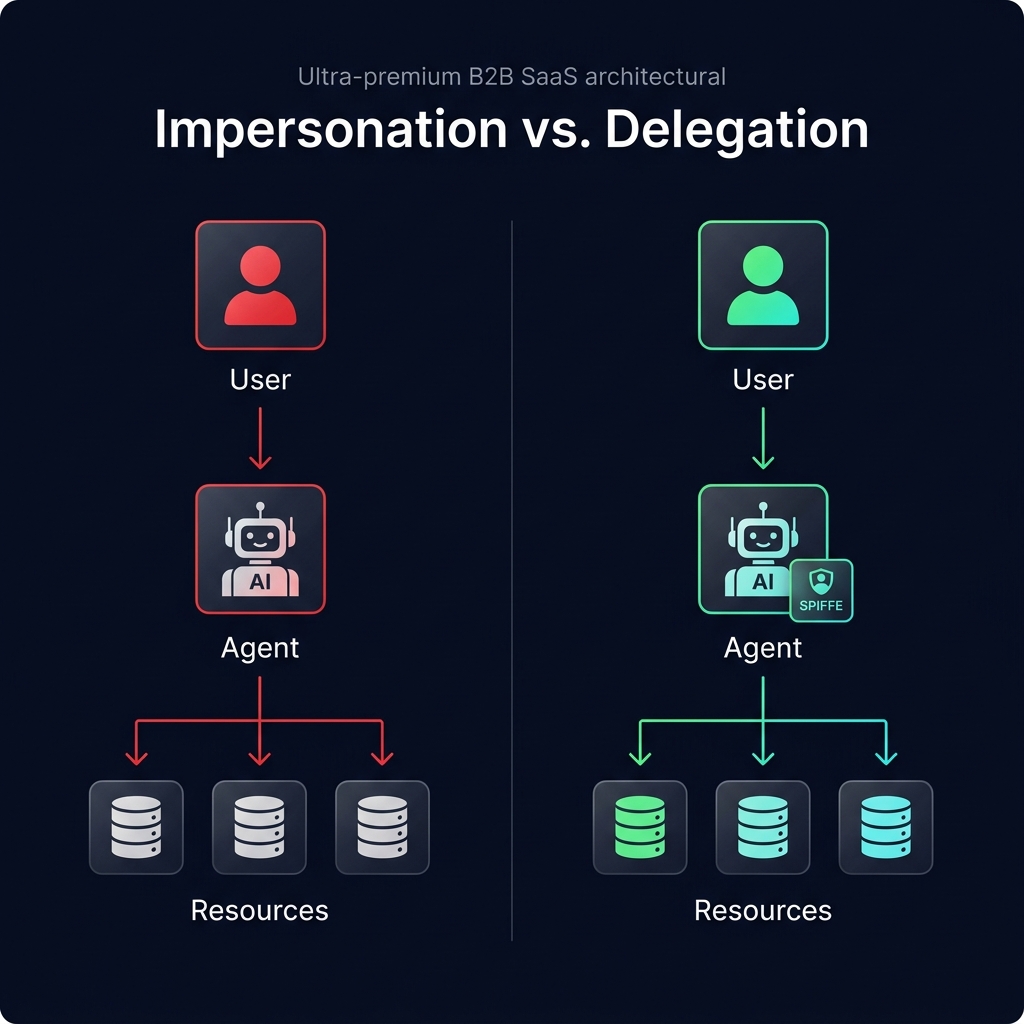
The structural metaphor is precise: impersonation is giving a contractor your master key. Delegation is issuing them a key that only opens the three doors they need, with your name still on the audit log as the authorizing principal.
How Agentic Architectures Are Multiplying the Governance Gap
LangChain, AutoGen, and CrewAI all share one identity assumption: the agent inherits the identity of the process that spawned it. This is not a configuration error — it is the default design. Combined with the provisioning velocity of agentic pipelines, it means the governance gap compounds faster than any manual review workflow can close it.
The accountability vacuum described above is being multiplied by agentic orchestration frameworks because those frameworks were not designed with enterprise IAM constraints as a first-class requirement. The provisioning velocity of machine identities already outpaces human governance workflows by orders of magnitude. Agentic orchestration accelerates that gap further.
LangChain tool-use chains, AutoGen multi-agent pipelines, and CrewAI role-based agent teams all share a common identity assumption: the agent inherits the identity of the process that spawned it. In a LangChain ReAct agent, every tool call is executed under the credentials of the application service account. If that service account was provisioned with broad access to "make the agent work," every tool invocation — whether searching a knowledge base or writing to a production database — operates under the same permission set.
Red Hat's May 2026 architectural guidance states the principle directly: "Agents can only reduce your access, never expand it." That constraint is not built into any current LangChain, AutoGen, or CrewAI release — it must be enforced at the IAM layer.
The challenge for governance is velocity. A single AutoGen pipeline can provision dozens of ephemeral agents in minutes, each inheriting the parent application identity. A manual governance workflow — access review, certification campaign, entitlement audit — cannot operate at that provisioning rate. This is not a resource problem headcount solves — it is a structural mismatch between human-paced governance and machine-paced identity creation. Identities provisioned faster than governance can follow will persist beyond their authorization window.
Three Architectural Gates That Close the Blast Radius
Three controls close the delegation gap: real-time agent discovery, cryptographically enforced ownership attribution via SPIFFE SVIDs and RFC 8693, and runtime least-privilege calculation enforcing the formula Effective Permissions = User Permissions ∩ Agent Capabilities. Each control is a prerequisite for the next. None is optional.
Three controls, implemented in sequence, move an organization from impersonation-by-default to governed delegation.
Continuous Discovery means every AI agent — whether spawned by LangChain, AutoGen, CrewAI, or a proprietary orchestration layer — is inventoried in real time with its runtime permission scope, parent identity, and last-action timestamp. Without this, the governance actions below have no target population to operate on.
Immutable Ownership Attribution means every agent identity carries a cryptographically verifiable link to the human principal who authorized its creation, enforced via SPIFFE SVIDs at the workload level and the RFC 8693 act claim at the token level. Attribution is not a field in a CMDB — it is a property of the identity credential itself, unforgeable and auditable.
Automated Least-Privilege Enforcement means effective permissions for every agent are calculated dynamically as the intersection of human sponsor permissions and agent capability scope — the formula Effective Permissions = User Permissions ∩ Agent Capabilities enforced at runtime, not set-and-forget at provisioning. This is the architectural implementation of Red Hat's stated principle, applied at the IAM control plane.
Actionable Knowledge Gap
Most organizations deploying agentic AI cannot answer six basic governance questions about each agent in production: identity primitive type, effective permission scope, human sponsor, delegation chain log, revocation mechanism, and maximum authorization duration. The IAM Posture™ LENS™ framework turns those six questions into a scored diagnostic that exposes exactly which controls are missing before a regulator or incident forces the answer.
Can you name, right now, how many AI agents in your production environment are operating under a human user's identity rather than their own — and what access each one has inherited?

Take the Free IAM Posture Assessment — Find Out Where Your NHI Governance Actually Stands
Fayaz Mulla Syed is an IAM and Cybersecurity leader and practitioner who has spent 13+ years at the forefront of enterprise identity — architecting, delivering, and evolving IAM programs across Life Sciences, Healthcare, Automotive, and Telecom. He brings rare depth across the full identity stack: from privileged access and identity governance to zero trust architecture and cloud identity — having worked hands-on in some of the most complex, regulated environments in the industry. He is the founder of IAM Posture™ — a vendor-neutral scoring platform built to cut through vendor noise and give organizations a clear, architectural view of where their identity program actually stands.